
“Trend-Pulse” is a trading system designed specifically for binary options trading. Unlike many “mechanical” approaches that rely solely on template-based crossovers or levels, this methodology treats the market as a living organism that responds to impulses, fatigue, and recovery.
The core idea of the strategy is not simply to determine which direction the price is moving, but to understand what stage of development the trend is in: whether it is just emerging, gaining strength, reaching its peak, or transitioning into consolidation. This helps avoid false entries at the end of impulses and capture the most probable continuation segments of the move.
It is worth noting that the Pocket Option trading platform is perfectly suited for trading binary options using the “Trend-Pulse” methodology. It offers all the necessary tools and chart timeframes. Additionally, the broker’s terminal is free from freezes and slippage, ensuring that contract purchases and sales are executed in a timely manner.
Philosophy and Key Principles
The strategy is built on three fundamental postulates:
- Strength matters more than direction – as long as the trend is strong, its direction is secondary. The key is not to enter against a powerful impulse.
- The phase of the move determines the tactic – at the start of a trend, more aggressive entries are acceptable; in the maturity zone, confirmation is required; in the weakening phase, it is better to stay out.
- Timeframe context is the decisive factor – the same signal on M1 and H1 carries opposite value. “Trend-Pulse” employs a multi-timeframe approach (HTF + LTF) without overloading the charts.
Recommended Assets and Conditions
Currency pairs with moderate to high volatility work best: EUR/USD, GBP/USD, USD/JPY, AUD/USD, as well as cryptocurrency pairs – BTC/USD, ETH/USD (during active trading hours, 10:00–22:00). The minimum deposit is $50, but for comfortable trading, $100 or more is recommended. Risk per trade should not exceed 2–3% of the deposit.
Expiry is selected dynamically: from 3 to 10 candles of the current timeframe (for example, on M5 – 15–50 minutes).
Tools and Settings
- ADX (Average Directional Index) – period 14. The primary trend strength filter.
- EMA (Exponential Moving Average) – period 21. Used solely for visual confirmation of slope and momentum.
- Price Action – key elements: inside bars, pin bars, false breakout of lows/highs.
- Timeframes:
- Higher (HTF): H1 – for determining the main direction and strength (via ADX).
- Working (LTF): M5 – for finding entry points and timing.
Step-by-Step Entry Algorithm
Trading with this methodology consists of several stages, which effectively filters out false signals.
Step 1. Analyze the Higher Timeframe (H1)
Open the H1 chart. Check the following:
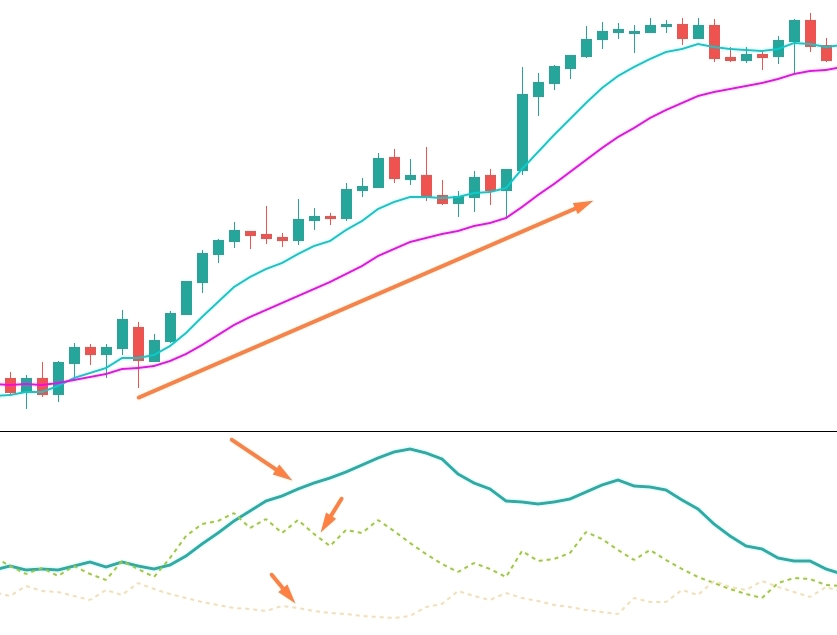
- ADX value > 25 – the trend is considered established.
- Which line is dominant:
- +DI > –DI – bullish context.
- –DI > +DI – bearish context.
If ADX < 20 – the market is in a flat/range-bound state. The strategy does not trade until the price breaks out of the range.
Step 2. Switch to the Working Timeframe (M5)
On M5, assess the phase of the local move:
- Phase 1 (Emergence): ADX on M5 is rising from 15–20 toward 25+, DI lines have just started to diverge.
- Phase 2 (Development): ADX 25–40, DI lines are clearly diverged, price is holding above/below EMA(21).
- Phase 3 (Maturity): ADX > 40, volatile impulses are possible, but volumes are starting to decline.
- Phase 4 (Weakening): ADX is falling, DI lines are converging, long-wicked reversal candles are appearing.
Step 3. Wait for an Entry Signal (Only in Phases 1–2)
Suppose on H1 there is an uptrend (+DI > –DI, ADX > 25). On M5, look for:
A confirmed pullback to EMA(21) or a demand zone (e.g., a previous local low).
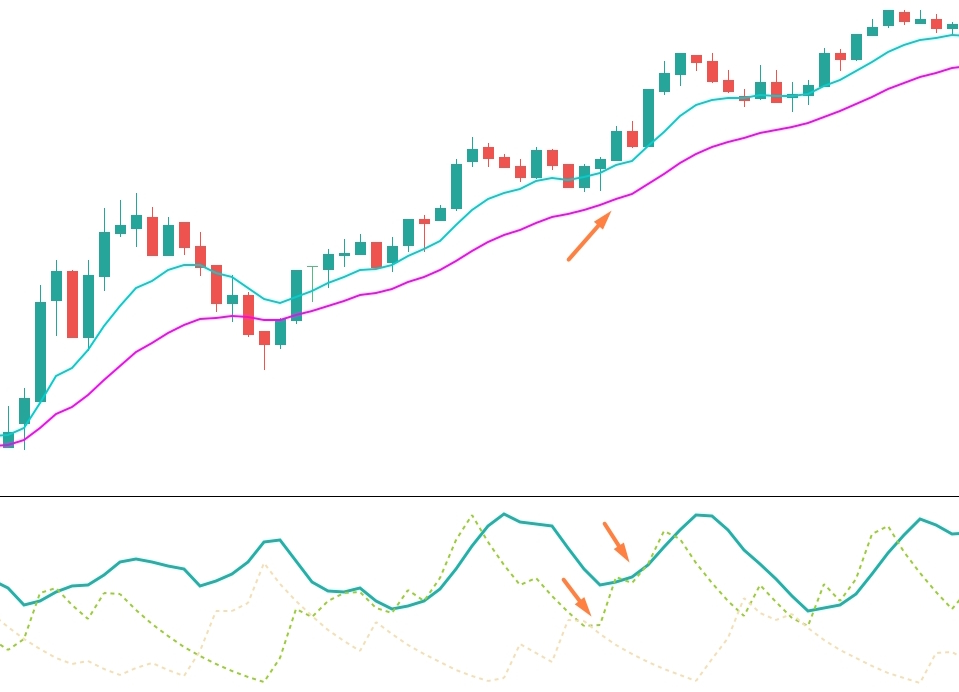
Formation of a bullish pattern:
- A pin bar with a long lower wick and a close in the upper third of the body.
- An inside bar following an upward impulse candle.
- A false breakout of a low with a sharp recovery upward.
A volume increase on the pattern’s closing candle – confirmation of major player participation.
ADX on M5 continues to rise or remains steadily above 25.
If all conditions are met – buy a CALL with an expiry of 30–50 minutes (for M5).
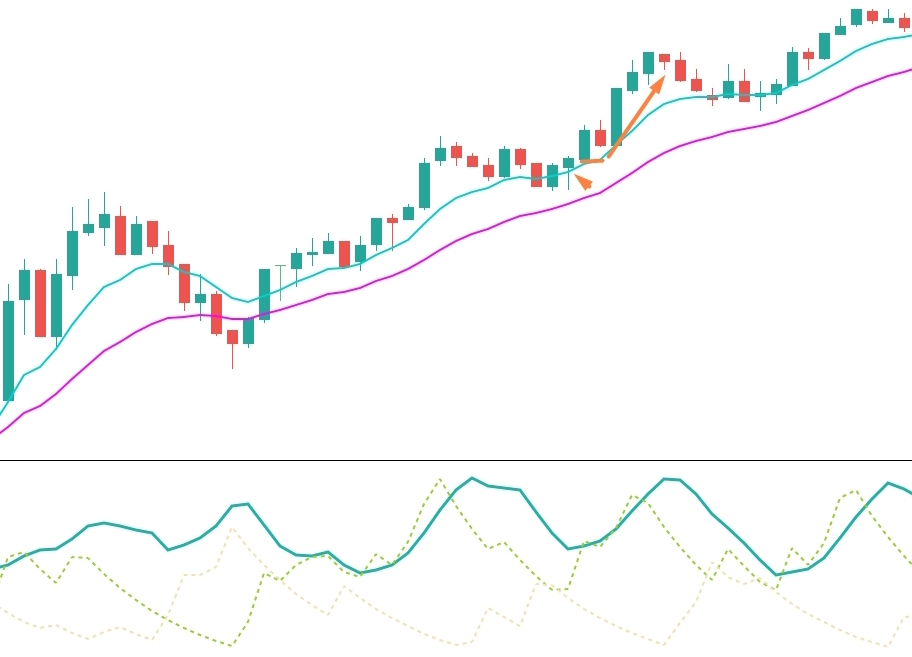
Similarly – in a downtrend, look for bearish patterns, and near EMA(21) – resistance zones.
Filters and Prohibitions
Under no circumstances should you enter a trade if:
- ADX on H1 < 20 (flat market).
- Price has moved more than 2 candles away from EMA(21) without a correction (“overheating”).
- ADX on M5 is falling while price is rising (divergence: “price up – strength down”).
- Less than 15 minutes before the release of major economic news (NFP, CPI, FOMC, etc.).
“Trend-Pulse” is a structured approach that increases the probability of a successful trade outcome by understanding market dynamics. It requires practice in recognizing phases and reading Price Action, but over time, this will inevitably bring you profit in the binary options market.