“Reflection” is a counter-trend, but not a reversal strategy. It is based on a fundamental market property: after a sharp, volatile move, the price almost always returns to the zone where the impulse began. This phenomenon is called a pullback to the balance point or an “impulse echo.”
Unlike classic retracement systems, “Reflection” does not wait for the 38.2% or 50% Fibonacci levels. It focuses on the structural starting point of the impulse—the area where the price broke through local support/resistance and accelerated. This is exactly where the market usually returns to “test” whether the zone of interest is still in demand among participants.
In this article, you will learn about one of the effective methods for trading digital contracts and the rules for setting up the Pocket Option trading terminal to apply it.
How does it work?
Digital contracts are a fixed-term instrument. Long reversals are unprofitable here. But short, predictable pullbacks are the ideal target. “Reflection” catches the second wave of the reaction: not the impulse itself (too fast), not a reversal (too slow), but the bounce from the impulse target back to its origin. Often, this takes from 15 to 45 minutes—optimal for options with a 5–30 minute expiration.
Market, Instrument, and Asset Requirements
This method is particularly effective on assets with pronounced intraday volatility and a clear structure:
- Currency pairs: GBP/JPY, EUR/JPY, AUD/JPY (high spread, but powerful impulses).
- Cryptocurrencies: BTC/USD, ETH/USD (during periods of high liquidity).
- Indices: US Tech 100, GER40 (react to American/European sessions).
Not recommended: Gold (too many false breakouts), exotic pairs.
Working timeframe: M1 or M3 – for maximum accuracy in localizing the impulse. Context analysis – on M15.
Required tools:
- Horizontal lines – to mark the impulse start zone and its target.
- Volume – as a histogram below the chart.
- Stochastic Oscillator (5, 3, 3) – to confirm overbought/oversold conditions at the target point.
- Candlestick analysis – a key element: look for an impulse candle (body length ≥ 3x the average candle over the last 10 periods).
Step-by-Step Trading Algorithm for the “Reflection” Strategy
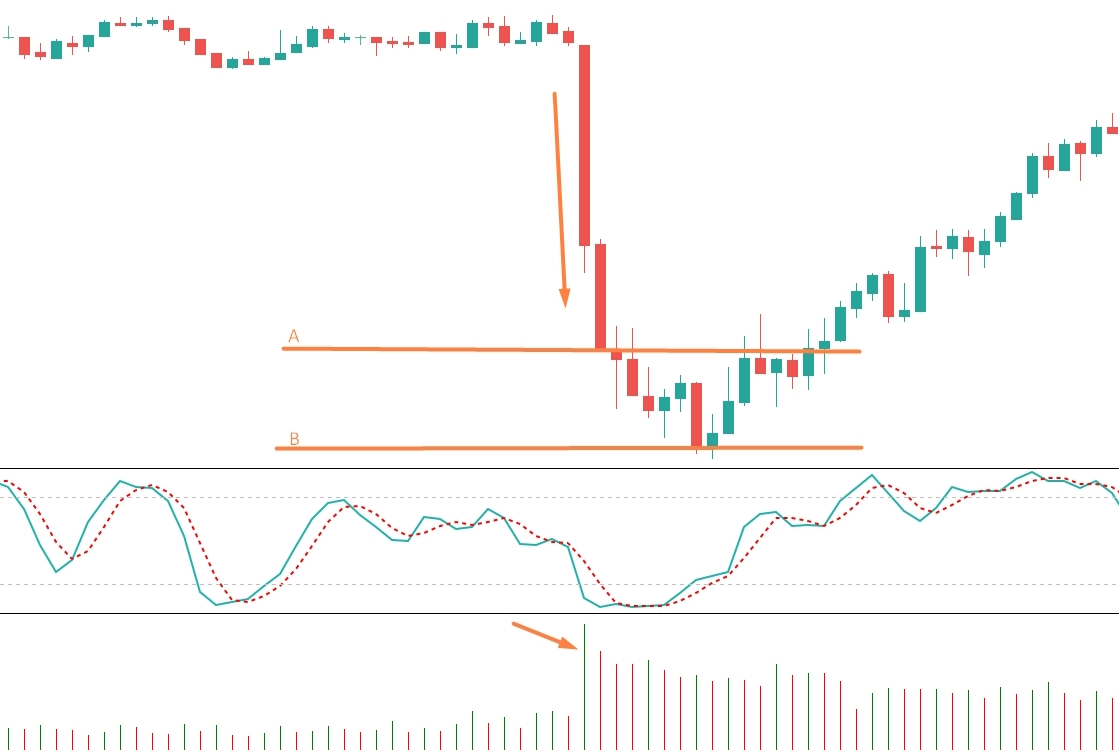
Step 1. Identifying the Impulse Wave (on M1/M3)
Look for:
- One or two consecutive impulse candles with small wicks and large bodies.
- A sharp volume spike – at least 2 times higher than the average over the last 20 bars.
- A clear breakout of a structural level (e.g., previous minimum/maximum, internal range of 5 candles).
Mark the following:
- Point A – the lower boundary of the impulse candle (for an uptrend) or the upper boundary (for a downtrend).
- Point B – the maximum/minimum reached within 5–10 candles after the impulse (“impulse target”).
The A/B distance is the amplitude of the impulse.
Step 2. Waiting for the “Echo”
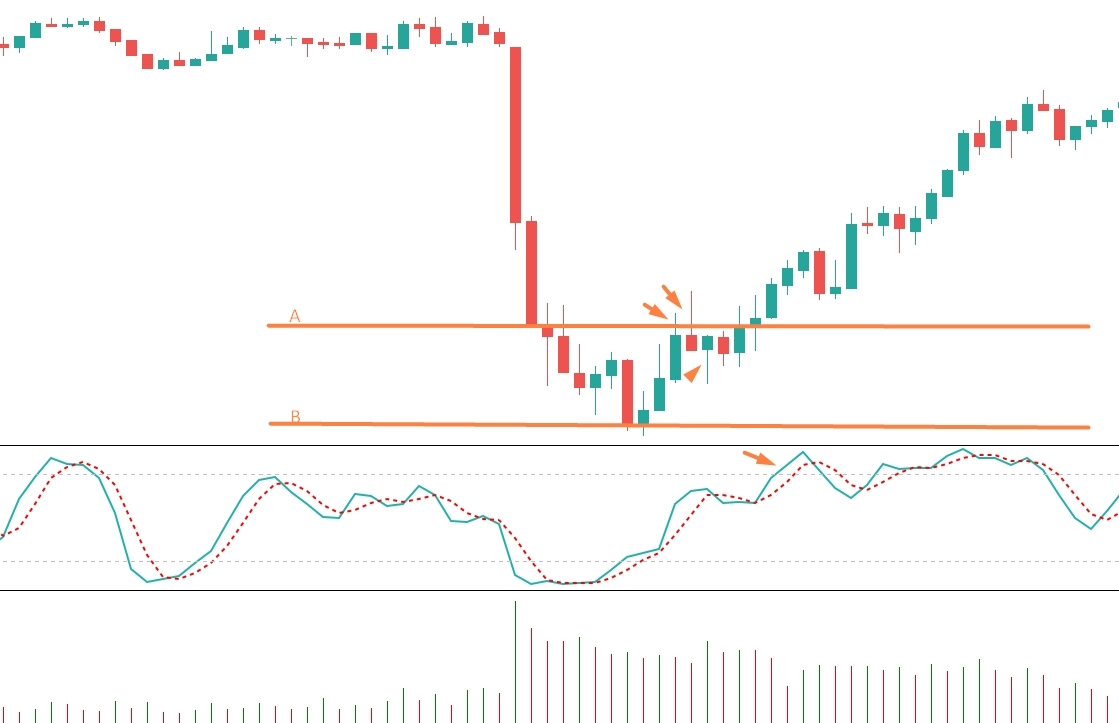
After reaching Point B, the price typically loses momentum:
- Volume drops sharply.
- Candles with long opposite wicks (“pin bars”) appear.
- The Stochastic moves into the >80 zone (for an uptrend) or <20 zone (for a downtrend) and starts to turn.
Step 3. Entering the Trade
The entry signal is generated when the price returns to the Point A zone ± 10–15 pips (for currency pairs) or ±0.3% (for cryptocurrencies).
Conditions:
- The price touches or breaks the Point A zone from below (for a CALL) / from above (for a PUT).
- The Stochastic crosses the signal line in the opposite direction (bullish cross – upwards, bearish – downwards).
- The volume on the entry candle is above average (confirming interest).
- Buy a CALL if the impulse was upwards and the price returns to Point A from below.
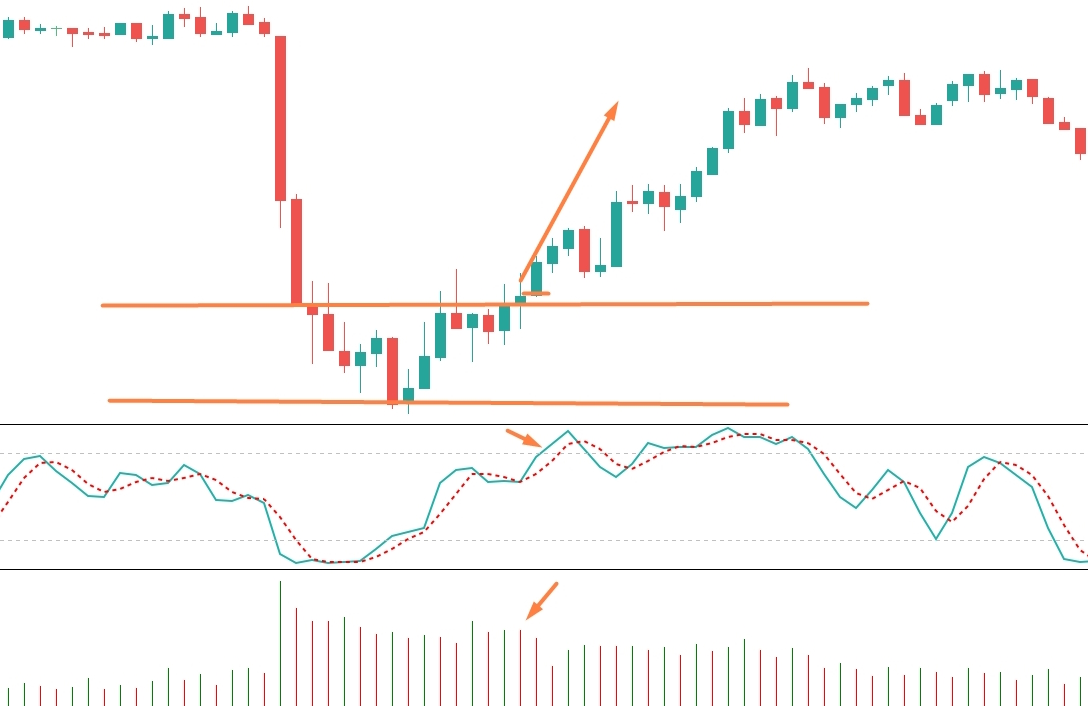
- Buy a PUT in the opposite situation.
Expiration: From 3 to 7 candles of the current timeframe (for example, on M3 this is 9–21 minutes).
The “Reflection” strategy requires patience. Sometimes there are no suitable conditions for 2–3 hours—and that is perfectly normal. This method is designed for those who value quality over speed.